Showing posts with label Clara Barton. Show all posts

Tuesday, June 4, 2013

Update on Traveling Clara Barton - Mailing TCB to Clara Barton NHS

Hello Junior Rangers!

Traveling Clara Barton Package
to mail to Clara Barton NHS for
the Clara Barton Civil War 150th
Anniversary Junior Ranger badge.
Today I am mailing out my Traveling Clara Barton package to Clara Barton NHS in Maryland. It's the final step in getting the Clara Barton Civil War 150th Anniversary Badge. The last stamp is from the Clara Barton NHS, so I have enclosed all of my Traveling Clara Barton sheets (I decided at the last minute not to cut them to pieces, lol) along with the NPS Activity Sheet and a letter to the Rangers over there. I really enjoyed my time visiting Clara Barton NHS, so I made sure to talk about that in my letter to them. If you ever get a chance to get to Maryland to go visit the site, you should; the Rangers there are very knowledgeable about Clara Barton and her life and have a lot of interesting stories and anecdotes. The tour was definitely worth waiting for. :)


So What's Next?

It's exciting that the quest for this badge is coming to a close and I can focus my attention on a different one. I'd like to go for the Civil War Historian Junior Ranger Patch next... but it occurs to me that I have a lot of books left over from my road trip vacation last month that are still needing to be completed and/or mailed out. Hmm... Yorktown comes to mind... =/

Will let you all know what I decide to pursue next and when Traveling Clara Barton comes back to me, of course. :) But in the meantime...

Explore On, Junior Rangers! :)

Friday, May 31, 2013

Update on Traveling Clara Barton: Fairfax Station Railroad Museum

Traveling Clara Barton from Fairfax Station Railroad Museum
Traveling Clara Barton from
Fairfax Station Railroad Museum

Well, Traveling Clara Barton has been pretty quiet as of late, but today I got my last stamp for my sheet before I mail it to Clara Barton NHS. This time it is from Fairfax Station Railroad Museum in Virginia.

Clara Barton Stamp from Fairfax Station Railroad Museum
Stamp from Fairfax Station
Railroad Museum
This one was pretty boring too. I just got my stamp back in an envelope. But yay! I am basically done with Traveling Clara Barton. All I have to do now is cut out all my stamps and paste them together and mail it with my completed Junior Ranger activity worksheet over to Clara Barton NHS. Then I will get the last stamp (which is from Clara Barton itself) and the badge. :)

One step closer to the Clara Barton Civil War 150th Anniversary Junior Ranger badge. Five down, one to go! :)


About Fairfax Station Railroad Museum

Fairfax Station Railroad Museum today
Fairfax Station Railroad Museum Today
Photo Courtesy fairfax-station.org
The Fairfax Station Railroad Museum is NOT administered by the National Park Service. The Museum and Gift shop are open on SUNDAY ONLY from 1:00 p.m. to 4:00 p.m. There is an admission fee ($3 adults, $1 children) and specialized tours are available if you pre-register for them. Special events are also offered at special admission rates ($5 adults, $1 children).


Early History of Fairfax Station Train Depot

Historical Marker at Fairfax Station
Photo Courtesy fairfax-station.org
The original Fairfax Station was built by Irish immigrants in the 1850s. After being hired by the Orange & Alexandria Railroad Company, they settled into the area surrounding the depot and established a community there. Because the new Irish settlers brought their Catholic faith with them, they decided to build a church for themselves, which would be called St Mary of Sorrows. This church would later be instrumental to the aid effort Clara Barton provided soldiers during the Civil War. 

The Fairfax Station served as the county seat of Fairfax, and when it was used as such, it was known as the Fairfax Court House. The developers made sure to locate the Station away from the town because the residents did not want to be around the smoke and noise of the trains that would be using the tracks they were building. The prominent families in the village and surrounding areas played an important role in the economic development and politics of the area. Its citizens also served in the wars engaged by the United States.

Fairfax Station and the Civil War

Southern Railroad Train Caboose at Fairfax Station Museum
Southern Railroad Train Caboose on display at the Museum
Photo Courtesy fairfax-station.org
The railroad which served this train station was the Orange and Alexandria Railroad and in 1860, it connected Alexandria to Lynchburg. The idea behind the railroad was to get farm products to Alexandria and Washington, while getting supplies from these big cities back to the farms. During the Civil War, the railroad and particularly Fairfax train station, gained strategic value as a method of moving troops and supplies. It was the most direct route to move troops between Alexandria and Richmond; therefore sparking attacks and defenses with the railroad's position always in mind. Many Civil War battles were fought over and along the railroad line, and the train station aided in all of them.

It first served as a supply base for Union forces during the summer of 1862. Later that year, it would become a center for emergency treatment and evacuation of the wounded soldiers following the battles of 2nd Manassas and Chantilly. The more than 3,000 soldiers served here would first be transported via wagon to the train station. They would be later put onto the trains and then evacuated to hospitals in Alexandria and Washington DC. As the last train of wounded soldiers left the station area, Union transportation officials gave the order to burn the station to the ground. This order was carried out on September 2, 1862. Unfortunately, there are no known photos of the original train station, but soldiers described it as a two story structure: Station Master's office on the second floor, with a passenger waiting room on the first.

After the Battle of Antietam, Union troops rebuilt the station; with a Union army supply base in mind, numerous buildings were constructed in the area as well. In August 1864, a skirmish occurred in the area between the train station and St Mary's Church. The Confederate soldiers were riding up the road from the station when they encountered the Union soldiers who had established a position at the church door. The Confederates won that engagement. 

Post-War Fairfax Station

Fairfax Station Railroad Museum
Fairfax Station Railroad Museum Today
Photo Courtesy fairfax-station.org
After the war, newer stations were built to accommodate the expansion of wealth that returned to the area. In 1894, the line adjacent to the Station became part of the larger Southern Railway. The rail line was double tracked by the early 1900s, and the last train station was built in 1903. It operated with great success until the late 1950s when trains became less popular, as more people began to travel by car and airplane; however, there was still a demand for trains to deliver packages and mail. When that demand also declined, Southern Railway began closing stations. Fairfax Station, the last passenger station in Fairfax County was closed down in 1973. It was saved from ruin by the Friends of Fairfax Station, who turned the historic site into the Fairfax Station Railroad Museum that it is today.


The Clara Barton Connection

Clara Barton
Clara Barton. Photo Courtesy nps.gov
Fairfax Station played an important role in the American Civil War. It was a major supply line and aided in transporting troops between Alexandria and Richmond, a vital route that both the Union and Confederate armies wanted to control. The result was many skirmishes along the rail line and the surrounding areas. The battles of Second Manassas (Bull Run) and Chantilly (Ox Hill) were fought in 1862. It was during these battles that Clara Barton and her four assistants arrived by train to Fairfax Station. 

Clara Barton used Fairfax Station as an important supply and medical evacuation site during the Civil War as she assisted with relief and evacuation efforts. It was at St Mary of Sorrows Catholic Church and the hill leading to the railroad tracks that Clara Barton and her crew would nurse the wounded before they were transported from the depot to hospitals in Alexandria and Washington DC. 

What she saw during her time there shocked her. According to the soldiers that were there, the downstairs passenger waiting room of the station was used as an amputation center. She later said: "a little bad of almost empty handed workers, literally by ourselves in the wild woods of Virginia with 3,000 suffering men crowded upon the few acres within our reach."

Over 3,000 wounded Union soldiers would be brought to the station. It would take many days to fill the trains with the wounded soldiers. So Clara Barton's role was to attend to the wounded while they waited to board the outbound trains. Aside from nursing the wounded, she and her crew would also cook and distribute food and water. On the last day at the station, she and others loaded patients onto the train as bullets from the battle surrounding them flew all about them. Finally, Clara Barton would board the train with the last remaining injured men and as they pulled away from the station, she watched as the station was overcome by Confederate troops.

Clara Barton would later be known for her efforts here, as one of several sites where she tended to the wounded throughout the many engagements of the Civil War. 

Sources: fairfax-station.org, nps.gov

Explore On, Junior Rangers! :)

Thursday, May 23, 2013

Update on Traveling Clara Barton - Antietam National Battlefield


Traveling Clara Barton from Antietam National Battlefield
Traveling Clara Barton from Antietam
National Battlefield.
This has been a busy week for Traveling Clara Barton! I have gotten back yet another stamp for my Traveling Clara Barton. This time it is from Antietam National Battlefield.

This one was pretty boring too. I just got my stamp back in an envelope. It makes me appreciate the people over at Andersonville and Missing Soldiers Office a lot more for taking that extra step to make our correspondence more meaningful, lol. :) I kinda wonder where it has been though because it was folded up in half too…which I didn’t do… weird.
Traveling Clara Barton stamp from Antietam National Battlefield
Stamp from Antietam National Battlefield

Anyway, I am getting very close to finishing my Traveling Clara Barton. I just have to wait for Fairfax Station to get back to me and then I can send everything out to Clara Barton NHS for the last stamp and the badge.

One step closer to the Clara Barton Civil War 150th Anniversary Junior Ranger badge. Four down, two to go! :)


About Antietam National Battlefield

This site honors the Battle of Antietam, a twelve-hour campaign which occurred on September 17, 1862 in which 23,000 soldiers were left dead, wounded or missing. The Battle of Antietam ended the first invasion of the Confederates into the North; it also led to President Lincoln’s issuance of the preliminary Emancipation Proclamation, which effectively launched the war into its new purpose: ending slavery.

For those Junior Rangers keeping track, you can get a Junior Ranger badge and certificate from Antietam National Battlefield; the book is available online.


The Antietam Campaign: The Bloodiest One-Day Battle in US History


Fog over Sunken Road (aka Blood Lane) at Antietam
Fog over Sunken Road (aka Bloody Lane) at Antietam.
Photo Courtesy nps.gov
On September 17, 1862, just as dawn’s first light peeked through the fog, cannons and rifles began to fire in what would be a twelve-hour long savage campaign on the rolling farm fields of western Maryland. This battle would change the course of the Civil War and ensure the freedom of over four million Americans. It would also devastate Sharpsburg, and is still considered to be the bloodiest one-day battle in US History.

General Robert E Lee
Photo Courtesy nps.gov
Considered to be the climax of the Maryland Campaign of 1862, the Battle of Antietam was the first invasion of the North by General Lee and the Northern Virginia Armies, as the war began to shift northward. After Lee’s victory at the Second Battle of Manassas in August, he wrote to Jefferson Davis, the Confederate President, about his ideas for the next stage of the war. Lee wanted to keep the offensive and secure independence through victory in the North; influence the mid-term elections that were soon happening in the fall; obtain desperately-needed supplies; move the war out of Virginia; and to liberate Maryland from the “tyranny” of the North by appealing to the slave-owners’ sympathies.

Upon arrival in Frederick, Lee aimed to capture the Union garrison which was stationed at Harpers Ferry: a vital location on the Confederate lines of supplies and communication to Virginia. The 12,000 Union soldiers stationed there were a threat to the Confederate’s link with the south. Stonewall Jackson and half of Lee’s army were sent to capture Harpers Ferry, while the rest of the troops moved toward South Mountain and Hagerstown, Maryland.

Major General George B McClellan
Photo Courtesy nps.gov
President Lincoln called Major General George B McClellan to protect the capital and respond to the imminent invasion. He reorganized the Potomac Army and advanced toward the awaiting Lee. The armies first fought on South Mountain, a campaign where the Confederates tried to block the Union Soldiers at three different mountain passes; however, the Confederates were unsuccessful and retreated.

After this defeat at South Mountain, Lee considered returning to Virginia; however, when he found out that Jackson had successfully captured Harpers Ferry on September 15, Lee decided to begin a campaign at Sharpsburg. The Confederate army led by Lee positioned themselves on the high-ground west of Antietam creek, while other commanders maintained positions on the left, center and right. Though there was strength in this position, there was also a weakness: with the Potomac River at their backs, there would be only one way to return to Virginia.

Meanwhile, the Union soldiers, led by McClellan, positioned themselves on the east side of Antietam. The idea was to drive Lee away from Maryland by attacking the left, then the right, and then eventually advance in the center when the flanks receded.

Major General Ambrose Burnside
Photo Courtesy nps.gov
The battle began at dawn on September 17. During the first seven hours, the Union led three major attacks against the Confederate left. McClellan’s plan soon disintegrated into a mess of uncoordinated Union attacks. This savage combat was fought on the areas known as the Cornfield, East and West Woods, and the Sunken Road; Lee’s men struggled against each of the Union’s advances. Entering hour eight of the battle, the Confederate army was pushed back, but not defeated. At this point, over 15,000 soldiers had been killed or wounded.

Burnside Bridge at Antietam
Burnside Bridge, Antietam National Battlefield
Photo Courtesy nps.gov
As the Union attacked the area of Sunken Road, General Burnside and his men attacked the Confederate’s right flank. His goal was to capture the bridge in the area. It took three hours for him to take the bridge. It was now 1 p.m., and Burnside and his troops regrouped and strategized for two hours before they decided to move forward. This delay cost them the advantage, as at that point, reinforcements led by Confederate General AP Hill had arrived from Harpers Ferry and forced the Union soldiers back.

The Confederate army’s flanks never collapsed far enough for McClellan to advance his center attack as he had planned, which left many Union soldiers alive since they never entered the battle. Both McClellan and Lee held their ground as the sun set; neither side admitting defeat.

The next day, September 18, both armies roamed the battleground gathering their wounded and burying the dead. Of the 100,000 men that engaged the battle, there were over 23,000 casualties. That night, Lee’s army withdrew back to Virginia, effectively ending Lee’s first invasion into the North. This provided President Lincoln the critical and long-awaited opportunity to issue the preliminary Emancipation Proclamation. An act which launched the war into its new purpose: Ending Slavery.


The Clara Barton Connection

Clara Barton on Conflict and Aiding Soldiers

Clara Barton, 1865

 
Dr James Dunn Quote about Clara Barton
Clara Barton was at the ready to aid the wounded soldiers during the Battle of Antietam on September 17, 1862. It took longer to arrive at the battlefield than she anticipated because her wagon was delayed behind the army’s massive supply line. Undaunted, she prodded her teamsters to drive the mules all night to get closer to the front lines. 

She arrived at the “Cornfield” battle area around noon. The medical surgeons stationed there were desperately dressing the soldiers’ wounds with corn husks, as the army’s medical supplies were slow in arriving compared to the quick-moving troops at Antietam. At her arrival, she delivered a wagon full of bandages and medical supplies she had personally collected over the course of a year.

She immediately settled into work. Her first surgery was performed at Antietam; she removed bullet from a soldier’s face, using—get this—her pocketknife. There was a woman there who dressed as a man to become a soldier in the army, and Barton also attended to her wounds. She prepared food for the injured soldiers and brought them water.

Her work at Antietam marked the first time she worked during a battle—and it was almost her last. As the battle raged on around her, she brought an injured solider a cup of water for him to drink. Kneeling down to give him the drink, she felt her sleeve shudder slightly. She later described the incident in these words: “A bullet sped its full and easy way between us, tearing a hole in my sleeve and found its way into his body.” (She never mended the bullet hole in her sleeve.) The soldier that was struck died in her arms, and the tough and valiant Clara Barton left him and moved on to the next soldier to continue working. It continued on-and-on like this until dark. The surgeons were hindered by the darkness; however Barton had brought lanterns with her in the wagon of supplies, so the doctors were able to continue their efforts through the night.
Clara Barton Memorial at Antietam
A Memorial to Clara Barton
stands at Antietam

Photo Courtesy nps.gov

After the Confederates retreated, the wagons of extra medical supplies were moved into Sharpsburg. Barton collapsed from sleep-deprivation and an onset of typhoid fever. She returned to Washington exhausted and delirious; however when she regained her strength, Clara Barton again returned to the Civil War battlefields, undaunted by her harrowing experiences at Antietam, to aid those who needed help the most. Famously, she said: “I may be compelled to face danger, but never fear it, and while our soldiers can stand and fight, I can stand and feed and nurse them.”

Explore On, Junior Rangers! :)


Source: nps.gov

Photo Credit: Clara Barton, 1865.
Courtesy of redcross.org

Wednesday, May 22, 2013

Update on Traveling Clara Barton - Andersonville National Historic Site


Traveling Clara Barton from Andersonville National Historic Site
Package from Andersonville National
Historic Site:  Envelope, Traveling
Clara Barton, and NPS
Andersonville Brochure.

Stamp from Andersonville National Historic Site
Stamp on Traveling Clara Barton from
Andersonville National Historic Site
Got Stamp #3 today on Traveling Clara Barton! This one is from Andersonville National Historic Site in Georgia.

Another place which used my sticker. The folks over there sent me the standard issue NPS brochure of the site with my stamped paper. So that was nice because I got to read more about Andersonville. Those brochures are really informative. :)

One step closer to getting the Clara Barton Civil War 150th AnniversaryJunior Ranger Badge. Three down, three to go! :)


Andersonville National Historic Site

Andersonville National Historic Site is composed of three sites: Camp Sumter (the prison site), Andersonville National Cemetery, and the National Prisoner of War Museum.

For those of you keeping track of the Junior Ranger badges, it is possible to obtain three (3) Junior Ranger badges here: Andersonville NHS Junior Ranger, Clara Barton Civil War 150th Anniversary Junior Ranger and Civil War Historian Junior Ranger.

Camp Sumter and Andersonville National Cemetery

Andersonville, or Camp Sumter as it was officially known, was one of the largest Confederate military prisons that were established during the time of the Civil War. This prison was built in 1864 after officials decided to move their Richmond, Virginia prisoners to a place where there would be more supplies and security. This prison existed for 14 months and held more than 45,000 Union soldiers. There were many casualties (over 13,000) that resulted from numerous conditions such as disease and malnutrition.

The first prisoners were brought here in February, 1864. It is approximated that 400 soldiers were brought to Andersonville each day. By the end of June, there were approximately 26,000 men imprisoned in a space originally intended for 10,000. In August, the population swelled to 32,000.

As Confederate resources dwindled, all available resources were concentrated on its army. This action crippled the prison; Confederate government was unable to provide adequate supplies or care to their Union prisoners. The mortality rate skyrocketed to about 100 prisoners a day.

On September 2, 1864, as Union troops closed in on Andersonville, the Confederates decided to move most of their prisoners to other camps in South Carolina and Georgia; however, the prison continued to operate on a smaller scale with the remaining prisoners.

Andersonville prison ceased to exist in May 1865. Many of the prisoners returned to their pre-war lives. In July and August of 1865, Clara Barton, laborers and soldiers, and Dorence Atwater (a former prisoner himself), came to the cemetery at Andersonville to identify and mark the graves of the dead Union soldiers. While he was in the prisoner, Atwater was in charge of recording the names of the soldiers that died. He had made a copy of the death record at the end of the war, which combined with Confederate records, they were able to mark all but 460 graves.

Andersonville National Historic Site and the National Prisoner of War Museum

Andersonville National Historic Site, and within it the National Prisoner of War Museum, is the only NPS site to serve as a memorial to ALL American prisoners of war, regardless of the conflict/engagement. Congress established this park to provide “an understanding of the overall prisoner of war story of the Civil War, to interpret the role of prisoner of war camps in history, to commemorate the sacrifice of Americans who lost their lives in such camps, and to preserve the monuments located within the site.” It was in 1998 when the National Prisoner of War Museum opened at Andersonville, and was dedicated to this purpose.


The Clara Barton Connection

Clara Barton raises the flag at Andersonville
Depiction of Clara Barton raising the flag over Andersonville
National Cemetery. Photo Courtesy of nps.gov

At the time of the Civil War, there was no system in place to document missing or dead soldiers. When the war ended, Clara Barton took it upon herself to fill this need. She began to receive numerous letters from soldiers’ family members asking what happened to their loved ones who did not return home from the war. Responding to these letters required a great deal of research which was difficult with the limited information available to Barton.
In June, 1865, Dorence Atwater contacted Barton and requested copies of her lists of missing soldiers. He had kept a copy of the death records at Andersonville. This would aid Clara Barton immensely in her quest to reply to the whereabouts of these missing soldiers. She contacted Edwin Stanton, the Secretary of War, and requested to join in the expedition to Andersonville so that she could help identify the graves at the site.

On July 25, 1865, Clara Barton arrived at Andersonville. At the time of her arrival, the difficult task of identifying and burying the dead was ahead of her. Atwater and Barton looked through the letters she had received and began to search the death and hospital records for the missing soldiers. This would continue for two months. During this time, laborers that had accompanied Barton began to build the gravemarkers. Barton was able to write many letters to inform families that their loved ones had died at Andersonville. At the end of this mission, she would identify and mark the graves of almost 13,000 soldiers. Barton also led the initiative to establish Andersonville National Cemetery. On August 17, 1865, it was Clara Barton herself who raised the flag over the newly dedicated cemetery site; a symbol which honored the soldiers who died in service to a grateful nation.

President Lincoln authorized Barton to gather information about the missing soldiers to inform their relatives, which began her Missing Soldiers Office in Washington in 1865. She hired many clerks, including Dorence Atwater, which would help her respond to more than 60,000 letters. Two years later, in 1867 when the Office closed, Barton’s agency had identified more than 20,000 missing soldiers—13,000 of which had died in Andersonville Prison.

Source: nps.gov


Explore on, Junior Rangers! :)

Tuesday, May 21, 2013

Clara Barton and the American Red Cross - Celebrating 132 Years of Service


Hello everyone! Here’s another installment of my series on Clara Barton, which I am writing as a part of my quest to get the Clara Barton Civil War 150th Anniversary Junior Ranger Badge.

Today is a special day to be talking about Clara Barton and her accomplishments because today, May 21, 2013, is the 132nd Anniversary of the American Red Cross! So, Happy Birthday American Red Cross! :)

The American Red Cross is dedicated to helping people in need throughout the United States and the world. They depend on monetary donations, blood donations and volunteers to support their lifesaving programs and services. Take some time to honor the American Red Cross by donating blood this week, or by donating money to help the victims of the devastating tornado which ravaged the state of Oklahoma on Monday.


Clara Barton, Founder of the American Red Cross
Clara Barton, Founder of the
American Red Cross.
Photo Courtesy redcross.org
Clara Barton founded the American Red Cross on this day in 1882 in Washington, DC. She was 60 years old at the time. Barton led the Red Cross for 23 years, during which time she engaged in numerous relief efforts and changed the face of humanitarian aid in the United States.


The Red Cross of the Geneva Convention: what is it by Clara Barton
Image Courtesy nps.gov

Clara Barton's informative
pamphlet about the Red
Cross for Congress and
the American People.
She was determined to start the American Red Cross after her involvement with the Red Cross humanitarian organization in Europe in the years following the Civil War. The officials in Switzerland recognized her determination and leadership capabilities and gave her a letter to take to President Hayes in an effort to sway him to sign the Geneva Treaty in 1877. He declined. A year later, in 1878, Barton wrote an informative pamphlet about the Red Cross to explain the organization to Congress and the American people. A transcript of the introduction is written here:

To the People of the United States, Senators and Representatives in Congress:
Having had the honor conferred upon me of appointment by the Central Commission holding the Geneva Convention to present that treaty to this Government, and to take in charge the formation of a National organization according to the plan pursued by the committees working under the treaty, it seems to me but proper, that while I ask the Government to sign it, the people and their representatives should be made acquainted with its origin, designs, methods of work, &c. To this end I have prepared the following statement, and present it to my countrymen and women, hoping they will be led to indorse and sustain a benevolence so grand in its character, and already almost universal in its recognition and adoption by the civilized world.
CLARA BARTON,Washington, D.C.


Despite her tireless efforts, the treaty would not be signed until 1882, when it was finally signed by President Arthur.

Clara Barton 1878
Photo Courtesy of nps.gov

Clara Barton, 1878,
wearing the Red Cross pin
given to her by the Germans
for her service during the
Franco-Prussian War.
 
For its first 20 years, with Barton as President, the American Red Cross was mostly involved with disaster relief. Their first project was to raise money and collect clothing to aid victims of a Michigan forest fire in 1881. Other projects included assisting with flood victims (1884) and aiding survivors of a dam break in Pennsylvania (1889). Their first international aid project was in 1892 where they helped the Russians during a period of famine by providing 500 railroad cars of cornmeal and flour. She would later aid the Germans in the Franco-Prussian War.

One of their more famous aid projects during Barton's tenure came in 1893 when a hurricane and tidal wave hit the Sea Islands of South Carolina, leaving over 5,000 people dead. She worked for 10 months helping the predominantly African-American population of the area recover, rebuild and reestablish their agricultural economy.


Her last project before she left the agency in 1904 was to assist with hurricane and tidal wave victims of Texas in 1900. She gave financial assistance and supplies to the survivors which were valued at over $120,000.


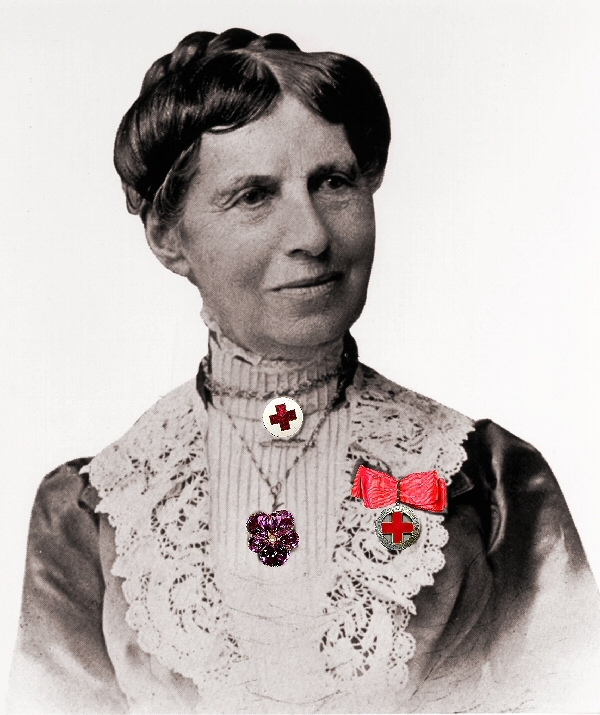
Clara Barton 1902
Photo Courtesy of nps.gov

Clara Barton, 1902.
In this color-retouched photo,
Barton wears the amethyst pansy
and Red Cross Pin given to her by
the Grand Duchess of Baden (Germany)
and the Imperial Silver Cross of Russia.
Barton was the Red Cross’ strongest advocate for the International Red Cross agencies to do more than provide wartime services. Although she was not the first person to suggest it (Henry Dunant was in 1864), Barton pushed to have an amendment to the Geneva Treaty passed that would allow relief to reach international victims of natural disasters in addition to the wartime services they provided. Some nations were unsure about the measure, but the resolution passed in 1864 and would later be known as the “American Amendment” to the Geneva Treaty. Because of her persistence and the passing of this resolution, it became possible for relief efforts to be expanded. Many countries honored her for this effort, including Germany and Russia for the relief she provided to those countries during the Franco-Prussian war and the Russian famine, respectively. The honors included the German Iron Cross and the Imperial Silver Cross of Russia.

After Barton left the Red Cross, the agency moved in a new direction. This new direction was marked during the Spanish-American War, when the organization delivered supplies and services to Cuba. This aid was distributed to American armed forces, prisoners of war and Cuban refugees. This action marked the first time that the organization provided assistance to both American armed forces and civilians during a war.

The American Red Cross has continued to grow and expand over the years. When disaster strikes, the world looks to the Red Cross for help; it is a force larger than itself, assisting others without judgment or prejudices. It has become a strong and recognizable symbol synonymous with relief efforts, both foreign and domestic, natural disasters or otherwise. And without Clara Barton's tireless efforts, none of it would have been possible.

Explore on, Junior Rangers! :)

Source:  redcross.org

Monday, May 20, 2013

Update on Traveling Clara Barton - Clara Barton's Missing Soldiers Office Museum Stamp


Traveling Clara Barton from Missing Soldiers Office
Package I received from Clara Barton's Missing Soldiers Office
Museum: Envelope, Letter from Superintendent Rosenvold
and Stamped Traveling Clara Barton.


Stamp from Clara Barton's Missing Soldiers Office
Stamp from Clara Barton's Missing
Soldiers Office Museum for
my Traveling Clara Barton.
One down, five to go! :)

So I checked my mail today… and guess what! I got my first stamp back on my Traveling Clara Barton, yay! :) A big thank you to Clara Barton’s Missing Soldiers Office Museum for returning my stamp and Traveling Clara Barton so quickly. One step closer to getting the Clara Barton Civil War 150th Anniversary Junior Ranger badge. :)

You can see the stamp here to the left. I was surprised to see that it was a custom stamp. I was expecting them to stamp it with the site's Passport Cancellation Stamp, which is usually what is handed out for these kinds of things.


Letter from Superintendent Rosenvold
Letter from Superintendent
Rosenvold from Clara Barton's
Missing Soldiers Office Museum.

The Superintendent of the site, Susan Rosenvold, also sent me a personal letter which thanked me for my interest in the site and included links to websites about the Museum, which apparently is not open because it is undergoing restorations. According to Superintendent Rosenvold, a date for the opening has still not been determined. Hopefully it will open soon. :)

Here are the sites Superintendent Rosenvold mentioned in her letter so you too can learn more about Clara Barton’s Missing Soldiers Office Museum:


Explore on, Junior Rangers! :)

Thursday, May 16, 2013

About Miss Clara Barton


Clara Barton
Clara Barton. Photo Courtesy of redcross.org
So since I’ve been doing so much talking about Clara Barton because I am working on getting my Clara Barton Civil War 150th Anniversary Junior Ranger Badge, I’ve decided to write a series of articles about Clara Barton and the NPS sites associated with her, which are the same sites that are participating in the aforementioned specialty Junior Ranger program. So this is the first in a series of articles about Miss Clara Barton’s history, and as such, I’ll start with an overview of Barton’s life.

Explore on, Junior Rangers! :)


Clara Barton 1875
Clara Barton, circa 1875.Photo Courtesy of redcross.org

It is said that this was her favorite portrait;
it would seem so, since she had it retouched
and the Red Cross badge added to it. :)

Clarissa Harlowe Barton, known to all as Clara, was born on Christmas Day 1821 in North Oxford, MA. She was the youngest of five children. She cared for her siblings in her youth, one of whom was seriously ill. The experience of taking care of her siblings became her primary “medical training.”

Clara worked as a teacher until 1854, when she moved to Washington DC to work as a recording clerk in the US Patent Office. She was working there in Washington DC at the start of the Civil War in 1861. When the 6th Massachusetts Infantry was attacked on their way to their post in Washington DC, the wounded soldiers were sent to the unfinished Capitol building to recover. Barton heard about their condition and brought supplies from her own home to aid them in their recovery. This action would be the start to a lifetime career of aiding others.

Clara Barton on Conflict and Aiding SoldiersDuring the course of the Civil War, she provided food, clothing and medical supplies to the sick and wounded soldiers. Aside from providing tangible materials to aid them, Barton would take care of the soldiers’ emotional needs as well. She would read to and pray with the soldiers and listen to their personal problems, all in an effort to keep their spirits up.

As the war went on, she continued to aid wounded soldiers in Washington DC and would learn how to store and distribute these supplies, and eventually was allowed to establish a supply distribution agency. Despite the great efforts she made on the “sidelines,” Barton knew that the greatest need was on the battlefields themselves. For years, she worked tirelessly to get permission to take her aid out to the battlefields; it wasn’t until 1862 that she would receive official permission to transport these supplies to the area battlefields.

Quote from Dr James Dunn about Clara BartonIt was in August 1862 when she delivered supplies to a field hospital at midnight after the battle of Cedar Mountain that the on-duty surgeon, Dr. James Dunn, would write this famous quote about Clara Barton: “At a time when we were entirely out of dressings of every kind, she supplied us with everything, and while the shells were bursting in every direction...she staid [sic] dealing out shirts...and preparing soup and seeing it prepared in all the hospitals...I thought that night if heaven ever sent out a homely angel, she must be the one—her assistance was so timely.” It it from here that the nickname “Angel of the Battlefield" is derived.


Clara Barton on Danger and DutyThroughout the course of the Civil War, Clara Barton aided countless soldiers and supplied battlefields in Maryland, Virginia and South Carolina during major battles. She would risk her life to do so by “following the cannon;” which means that she followed the troops as they marched into battle. And despite the fact that she never had any official training in medicine as a nurse or otherwise, she would assist in tending the wounded and sick soldiers. This was all in addition to providing the critically needed supplies to field doctors and surgeons as she always did.

Clara Barton 1865
Clara Barton, circa 1865.
Photo Courtesy of redcross.org

This photo taken by Matthew Brady in
Washington DC is the most famous and
widely circulated photograph of Miss Barton.
When the war ended in 1865, Barton established the Office of Correspondence with Friends of the Missing Men of the United States Army to help locate missing soldiers. This would later be known as the Clara Barton Missing Soldiers Office. During the four years this office operated, she received and answered more than 63,000 letters and identified over 22,000 missing men.  She was also involved in the effort to assist with the identification of soldier’s graves, and was instrumental in establishing a national cemetery at Andersonville. It was during this time that she was able to identify the graves of almost 13,000 men. She would later testify before Congress about her wartime experiences.

Clara Barton 1881
Clara Barton, circa 1881.
Photo Courtesy of redcross.org
Clara Barton founded the American
National Red Cross on May 21, 1881
at the age of 60.
After the war, in 1869, Clara Barton traveled to Europe on the advice of her doctor in search of “rest.” But she would not rest. It was during this time that she heard about the humanitarian organization known as the Red Cross based in Geneva, Switzerland. She aided many during her time in Europe by working with the volunteers of the International Red Cross. She became determined to bring the concept of the Red Cross to the United States, so when she returned, she immediately went to work to execute her vision. It wasn’t until 1881 that she was able to establish the American National Red Cross at the age of 60. Over the years, the organization that would later be known simply as the American Red Cross helped people both nationally and internationally during times of natural disasters and wartime.

Clara Barton 1904
Clara Barton, circa 1904.
Photo Courtesy of redcross.org

Clara Barton resigned as President
of the Red Cross in 1904, after
23 years of service.
Barton spent 23 years leading the American Red Cross. In 1904 she resigned from her post there as President. After leaving the organization she created, Barton immediately turned to work on a new project and established the National First Aid Association of America. This organization, though small and short-lived, worked on providing basic first aid instruction, emergency preparedness skills and developed what we know today as the first aid kit.

Clara Barton died at the age of 90 on April 12, 1912 at her home in Glen Echo, Maryland after a lifetime of intense and dedicated service to the needs of others. This house would become the Clara Barton NHS in 1975, and the first National Historic Site dedicated to the accomplishments of a woman.

Sources: biography.com and redcross.org